WRITTEN BY Kevin Moura & Matthew Williams
GRAPHICS BY Rowan Shea

Chinese New Year, a celebration of the lunar new year, has been celebrated for roughly 3,500 years, and is celebrated to this day. This year, it was celebrated on February 10, marking the Year of the Dragon, though its date alternates each year due to the lunar calendar. The celebration lasts fifteen days after the new moon and ends at the full moon. Since the 1990s, Chinese citizens that have jobs have been given a week off for the celebration of Chinese New Year since it’s such a special time of the year. During the celebration, bright lights, the color red and loud noises are commonplace, as they all represent different good-luck beliefs. It was said that a monster named Nian, meaning “Year”, would attack the citizens at the village as the year started. The monster was afraid of bright light, the color red, and loud noises, which is why those themes are associated with the celebration of the Lunar New Year.
One of the traditions of Chinese New Year is to thoroughly clean someone’s house before the new year in order to to wash away the evil spirits that are looming in their home. Some other traditions are coming together with family and friends and eating special traditional meals, and, on the last day of Chinese New Year, on the New Year itself, an event called the Lantern Festival is held. On this night, people carry bright, glowing lanterns and walk around in a parade, or hang them in temples. To finish off the celebration, dancers walk in the streets while carrying a long dragon displaying an array of colors, causing good fortune amongst the people in China.
Chinese New Year is special to the citizens in China, and impacts them warmly. The celebration drives away the potential evil or unwanted spirits, and brings good fortune at the end of the New Year.
In the Bay Area, the most famous Chinese New Year celebration and parade has been in San Francisco, due to the fact that Chinatown has a large concentration of Chinese-Americans and immigrants.
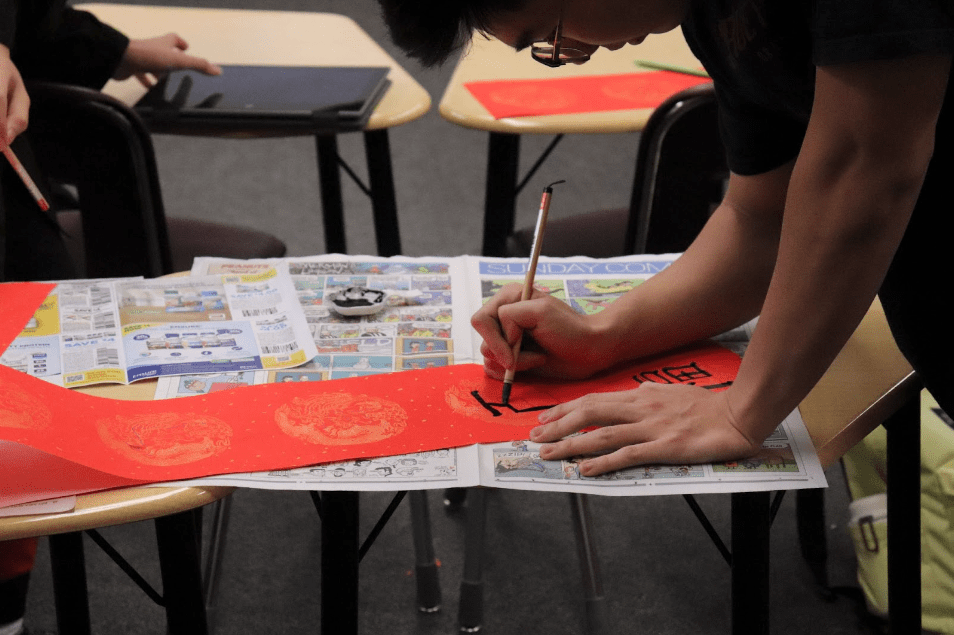
This year, a Chinese New Year celebration is being held at Las Lomas High School. In preparation for the big event, Mandarin 3 students at Las Lomas learned tasks to prepare for the Chinese New Year. Some students in the class were practicing calligraphy for the celebration. Nathan Stern, a sophomore, who was practicing his calligraphy skills, said, “It’s like a way of expressing their culture.” The characters traditionally painted bring in good fortune and ward off evil spirits.
Other students in the class were cutting paper cutouts for the celebration. Another Mandarin 3 student, sophomore Ishika Gill, said, “The paper cutting is for blessings. They hang it up in their houses for their blessings.” Both the calligraphy and paper cutouts are symbolic of the celebration, each celebrating different aspects of the lunar new year like good fortune or peace going into the new year, but overall to celebrate the Lunar New Year. These traditions were celebrated this year by the Mandarin classes at Las Lomas, but they can also be seen all across the globe.
As part of the celebration, the students of the Mandarin 3 sixth period class were practicing saying good things to their elders, in this case, the teacher. In return, they received a red envelope containing a Chinese coin called feng shui. The coin is round with a small square cut out in the middle. One side of the coin has Chinese characters inscribed on it to represent prosperity, peace, and protection, the other has two characters or sometimes is left blank depending on where the coins are from or what dynasty the coin represents. The square in the middle of the coin symbolizes the Earth, and the circle is the sky. The meaning of the coin is to bring good fortune and cast away evil. The fifth period mandarin class also held a celebration, sharing food with others and playing traditional Chinese games.
 The Las Lomas Page
Leave a comment